
Master of Science in Clinical Counseling
Albertus Magnus College’s 60-credit Master of Science in Clinical Counseling program is designed to be completed in 3 years, including 2 summer classes after the first year. Classes are offered in the evening so as to facilitate employment during the first 2 years and completion of the internship in the 3rd year. Some classes, particularly in the summer, follow an 8-week, accelerated, modular format. Most classes are fully on-ground, though some are offered in a blended/hybrid format.
The program is designed to lead to eligibility as a Licensed Professional Counselor (L.P.C.) in the State of Connecticut. (In addition to the master’s degree, candidates for licensure must obtain postgraduate supervised work experience and pass an examination.) Most professional positions in behavioral health require or strongly prefer that applicants possess or be eligible for licensure. Note that each state sets its own standards for licensure. Our program is likely to meet the standards set elsewhere, but it is the student’s responsibility to ensure that this is the case and to make up any deficiencies.
We offer two specialty tracks: mental health counseling and addiction counseling. Students apply for admission to one or the other. The mental health counseling track includes advanced coursework on assessment, psychotherapy, and case conceptualization. The addiction counseling track includes specialized coursework on psychopharmacology, addictive behaviors, and addiction counseling. Students completing the addiction counseling track will be eligible to apply for licensure as alcohol and drug counselors (L.A.D.C.) in addition to the L.P.C. Again, this will require appropriate experience and passage of an examination as well as the degree.
Our M.S. in Clinical Counseling has three distinct features:
- The ability to choose between two specialty tracks—Mental Health Counseling or Addiction Counseling. The Addiction Counseling track is distinctive in that, so far as we are aware, no other counseling program in the State of Connecticut features a complete menu of courses leading to Licensed Alcohol and Drug Counselor (LADC) credential.
- An emphasis on evidence-based practice (also known as empirically supported treatments). This is emphasized throughout the program, and especially by the advanced courses in contemporary modes of psychotherapy (or addiction counseling) as well as assessment, case formulation, and treatment planning.
- The integrated experiences in the final year of the program: a supervised internship (typical in most counseling programs) is combined with seminars in ethical issues and case formulation as well as the empirical thesis, which typically will involve client assessment and/or treatment effectiveness research conducted at the internship site.
The Curriculum
Year One
Year Two
Year Three
Do you want to make a difference in people’s lives?
Do you want to understand people more deeply?
To be skilled at helping them to make changes and develop into better versions of themselves?
Are you comfortable with close relationships, strong emotions, and self-reflection?
If you answered “yes” to these questions, then the M.S. in Clinical Counseling program at Albertus Magnus College may be the right place for you to study and grow. We want to cultivate the next generation of counselors and psychotherapists—to guide you through your own process of intellectual and emotional development.
Our program is housed in the department of psychology at an independent college sponsored by the Dominican Sisters. The department, which includes 10 full-and half-time members, operates three master’s degree programs (counseling, art therapy, and human services) as well as undergraduate majors. We pride ourselves on how well these programs fit into the college’s overall mission, which is to promote the search for truth in all its dimensions and provide an education that is both grounded in the liberal arts and practical in its application. We are situated in New Haven, a small New England seaport city that enjoys rich cultural opportunities and a remarkably diverse community.
Student Spotlight:
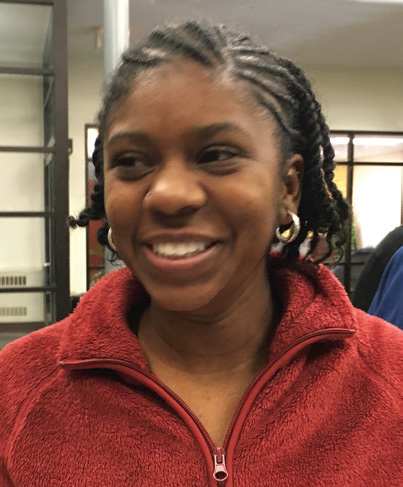
Whitney Bailey (December 2017)
Whitney Bailey (December 2017)
In the short amount of time that I’ve been at Albertus Magnus College, I have experienced nothing but acceptance and support from each of my professors, faculty members, and the diverse group of classmates I now call friends. Although the curriculum is challenging, the material is rich and meaningful, and the professors have done a phenomenal job of making lectures fun and engaging! I feel confident about this first semester, knowing that I did my best, and everything I’ve learned will be useful to me in the future. I can’t wait to see what new information will be covered next semester!
How to Apply
To be considered for admission to the Master of Science in Clinical Counseling program, applicants must submit the following:
- A completed application form and a $50 non-refundable application fee;
- Official transcripts reflecting conferral of a bachelor’s degree with a GPA of 3.00 or higher. (All transcripts are to be submitted from the original institutions.);
- At least 15 credits in psychology, including a class in statistics;
- ONE of the following:
- A substantive writing sample (such as a term paper from an upper-level class) OR
- Scores on the general test of the Graduate Record Examination (GRE)
- Two letters of recommendation from former professors or supervisors;
- A personal statement of 250–500 words detailing the applicant’s motivation and self-assessed suitability for a career in counseling;
- An interview with one or more program faculty members.
Applicants whose grades or coursework fall short of the above criteria may, at the discretion of program faculty, be offered admission on a conditional or probationary basis. Decisions concerning admission will be made based on a holistic review of the complete application.
All application materials should be sent to:
The Master of Science in Clinical Counseling Admissions Committee
Division of Professional and Graduate Studies
Albertus Magnus College
700 Prospect Street
New Haven, CT 06511-1189
Professional Counseling Associations
American Counseling Association (ACA)
|
The ACA, with about 70,000 members, is the one professional group for counselors of
all varieties. It includes 20 divisions (specialty areas), of which the largest are
those for mental health counselors and school (guidance) counselors; rehabilitation
counselors, career counselors, and addiction counselors (see below) are also well
represented. The ACA is an important organization. It operates certification programs
(NCC and CCMHC) that are linked with state counselor licensure systems. The web page
includes a career center with job listings. |
National Alliance on Mental Illness
Substance Abuse and Mental Illness Services Administration
Connecticut Mental Health Counselors Association
Connecticut Counseling Association
|
This is the local ACA affiliate. |